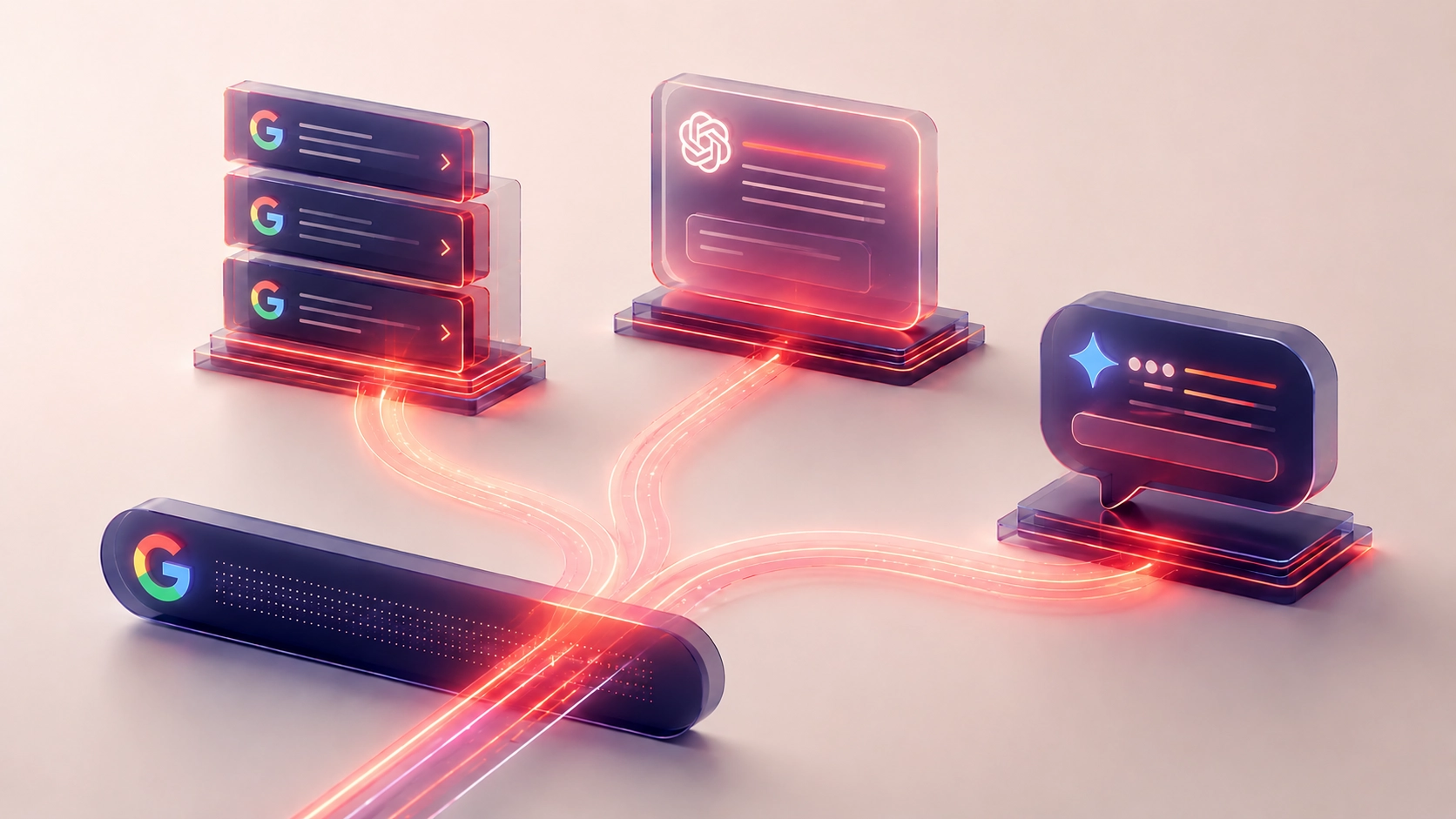
Search is now three surfaces: SEO ranks you in links, AEO sources the quick answer, and GEO gets you cited inside AI chats. They run on two mechanics, training memory and live retrieval, and the first step is simply letting AI reach your site.
A few years ago a search was one thing: type a query, get a list of links, and the job was to rank in that list. Today the same intent produces three different results. There is still the list of links, but above it sits a boxed answer the user may never scroll past, and alongside it the same person increasingly asks ChatGPT or Perplexity directly, where your brand is either named or simply absent.
Those are three separate contests, and they are won in three different ways. Most teams optimize for one and assume it covers the rest, which is why a site can rank well and still be invisible the moment a buyer asks an AI the same question. Understanding what each battle rewards, and the machinery underneath them, is what separates brands that show up in AI answers from brands that quietly disappear from them.
SEO, AEO, GEO: what the three actually mean
The three terms describe the same user looking for the same thing across three surfaces. Getting them straight is the start of treating them as the distinct problems they are.
- SEO, search engine optimization: ranking in the classic list of blue links. This is the surface everyone already knows.
- AEO, answer engine optimization: being the source behind the direct answer at the top, the featured snippet or the Google AI Overview that resolves the query without a click.
- GEO, generative engine optimization: being named or cited inside an AI chat answer, when someone asks ChatGPT, Gemini, or Perplexity rather than typing into a search box.
They overlap, but they do not reward the same things, and a win on one does not transfer automatically to the others. To see why, you have to look at how an AI answer is actually produced.
How AI search actually works
An AI answer comes from one of two mechanisms, and you have to win both. Either the model answers from what it already learned during training, or it runs a live web search at the moment of the query and cites what it finds. The first rewards being a known, trusted entity. The second rewards being reachable and well-structured right now.
The training branch is the model's memory. ChatGPT, Claude, and Gemini answer many questions straight from knowledge baked in before their cutoff, so to be in that knowledge you had to be published, indexed, and recognized as credible across the web before training happened. You cannot optimize a page this week and appear in it. This branch is about durable, distributed reputation, not a single page.
The retrieval branch is live web search, usually called retrieval-augmented generation. The model searches the web at query time, reads candidate pages, and synthesizes a cited answer. Perplexity does this on every query, ChatGPT triggers it mostly on commercial-intent searches like "reviews," "alternatives," or anything with a year in it, and Google's AI Overviews use it with query fan-out, breaking one question into several and pulling from the same index that ranks normal results. This branch behaves like classic SEO: being indexed, relevant, fresh, and clearly structured is what gets you retrieved and quoted. Perplexity, for example, tends to read around ten pages per query and cite only three or four, favoring recent, source-backed, well-structured content.
So the two mechanics map cleanly onto two levers. The training branch is won with trust and brand presence across the web. The retrieval branch is won with SEO and clean, accessible structure. That is the whole reason AEO leans on your SEO while GEO leans on your reputation.
Why most teams get AI search wrong
The common mistake is treating 'AI search' as a single thing and assuming strong SEO automatically wins it. It does not. The surfaces run on different mechanics, so a tactic that earns Perplexity citations can do nothing for ChatGPT or for Google's AI Overviews. One 2026 analysis of tens of thousands of AI responses found citation rates differing by more than forty times between platforms, with ChatGPT naming brands in well under one percent of answers while Perplexity did so far more often. Optimizing all three identically is like running one campaign unchanged across LinkedIn and TikTok.
The relationship between them is the part worth internalizing. In its May 2026 guidance, Google stated plainly that its AI features are still SEO, built on the same ranking and quality systems as ordinary Search, and that the large majority of sources cited in AI Overviews come from pages already ranking near the top. So AEO sits directly on top of your SEO foundation. GEO, and especially the training branch behind chat answers, sits on top of your trust. Get those two relationships right and the rest of AI search stops feeling random.
The mistake that quietly deletes you from AI search
Before any content tactic, make sure AI can physically reach your site. The most common reason a brand is missing from AI answers is not weak content. It is that the brand's own infrastructure is blocking the crawlers that feed those answers, and almost nobody checks for it.
Two layers cause this. The first is robots.txt, where AI crawlers are often disallowed by an inherited default or a copied configuration nobody revisited. The second is more insidious. Cloudflare now blocks AI crawlers by default on newly created domains, and that block runs at the network level before robots.txt is ever read. A bot like GPTBot never reaches your server, so even a perfect robots.txt cannot save you. A brand can have excellent content, clean markup, and strong third-party coverage and still score zero across every AI model. That is a plumbing problem, not a content problem, and the fix takes about ninety seconds in a dashboard once you know to look.
There is one distinction that makes this a real decision rather than a switch. Training crawlers and search crawlers are now separate bots: training collectors like GPTBot and CCBot are different from the search and retrieval bots like OAI-SearchBot and PerplexityBot that actually feed cited answers and send referral traffic. Treating them as one bucket is the core error. You can reasonably block training crawlers if you do not want your content used to train models, but if you block the search and retrieval bots you remove yourself from the AI answers your customers now read, in a channel where referral traffic has grown nearly tenfold in a year. Auditing this access layer is the unglamorous first thing we check on any AI search optimization engagement, because no content strategy matters if the door is bolted.
The myth that is wasting your time
The loudest myth in AI search right now is llms.txt, a file you are told to add so AI models understand and favor your site. It does nothing for AI visibility, and the evidence is no longer ambiguous. Google's own search representatives have compared it to the long-discredited keywords meta tag, since it is controlled by the site owner and therefore trivial to manipulate, and Google has confirmed it does not support the file and has no plans to.
It went further than statements. Google's 2026 guidance on AI search includes a mythbusting section that names llms.txt directly as a tactic that does not help, and when the file briefly appeared in Google's own developer docs in late 2025 it was removed the same day and explicitly called not an endorsement. Independent analysis of hundreds of millions of AI bot requests found that the crawlers which actually drive citations almost never request the file at all. The practical takeaway is simple: skip it, and spend the time you would have spent on access, structure, and trust instead.
Trust is the currency of AI search
Once AI can reach you, the thing that decides whether it cites you is trust. For the GEO and training branch, trust is close to everything, because a model recommends the entities the web has repeatedly treated as credible, long before any single query. For AEO and the retrieval branch, trust still matters, but it sits on top of SEO, since you have to rank and be retrievable before structure and credibility can do their work.
In practice that means two different investments. The retrieval branch rewards a strong SEO base plus pages built to be quoted: clear question-led headings, direct answers, specific statistics, named sources, and current dates. The training branch rewards something slower and harder to fake, a distributed reputation built from mentions, reviews, and citations on sites other than your own. That off-site trust is a large enough subject to stand on its own, and it is the focus of our companion guide on earning AI's trust in your brand, which goes deep on where that credibility actually comes from.
A practical checklist for all three battles
Work the three surfaces in order of leverage, not in order of hype.
- Unblock the bots first: audit robots.txt, Cloudflare, and any firewall so retrieval crawlers can reach you, and make a deliberate choice about training crawlers.
- Keep the SEO foundation strong: AI Overviews and on-demand retrieval pull from the same index that ranks links, so ranking still underpins AEO.
- Structure content to be quoted: lead sections with clear questions and direct answers, and support them with statistics, named sources, and current dates.
- Build distributed trust: earn the third-party mentions, reviews, and citations that the training branch rewards.
- Ignore the hype files: skip llms.txt and put that time into access, structure, and reputation.
One search box became three surfaces. SEO ranks you in the links, AEO makes you the source behind the quick answer, and GEO gets your brand named inside AI chats, and they run on just two mechanics, the model's training memory and live retrieval, steered by two levers, trust and SEO. Make sure AI can reach your site, keep the search foundation strong, build the reputation the models reward, and skip the shortcuts that do not work. That is the work we do on every search engagement, because being found is no longer one battle, and winning one does not win the others.
What is the difference between SEO, AEO, and GEO?
SEO is ranking in the list of links. AEO is being the source behind the quick answer or AI Overview at the top. GEO is being cited inside an AI chat answer from ChatGPT, Gemini, or Perplexity.
Does good SEO automatically win AI search?
Partly. Strong SEO underpins AEO and live retrieval, but the training branch behind chat answers depends on distributed trust, which SEO alone does not build.
How do AI chatbots decide what to cite?
Two ways. They answer from training knowledge, which rewards being a known entity, or they search the live web and cite what they retrieve, which rewards being crawlable, fresh, and well-structured.
Why is my brand not showing up in ChatGPT or Perplexity?
Often the crawlers cannot reach you. Check whether robots.txt or Cloudflare is blocking AI bots, since that alone can make strong content invisible to every AI model.
Is Cloudflare blocking AI crawlers on my site?
Possibly. Cloudflare blocks AI crawlers by default on new domains, at the network level before robots.txt is read, so you have to check and adjust it in the dashboard.
Should I add an llms.txt file?
No. Google does not support it, names it in its mythbusting guidance, and the bots that drive citations almost never request it. Spend the time on access, structure, and trust.
Should I allow AI training crawlers?
That is a choice. You can block training crawlers like GPTBot if you do not want your content used for training, but you must allow search and retrieval bots, or you remove yourself from cited AI answers.